

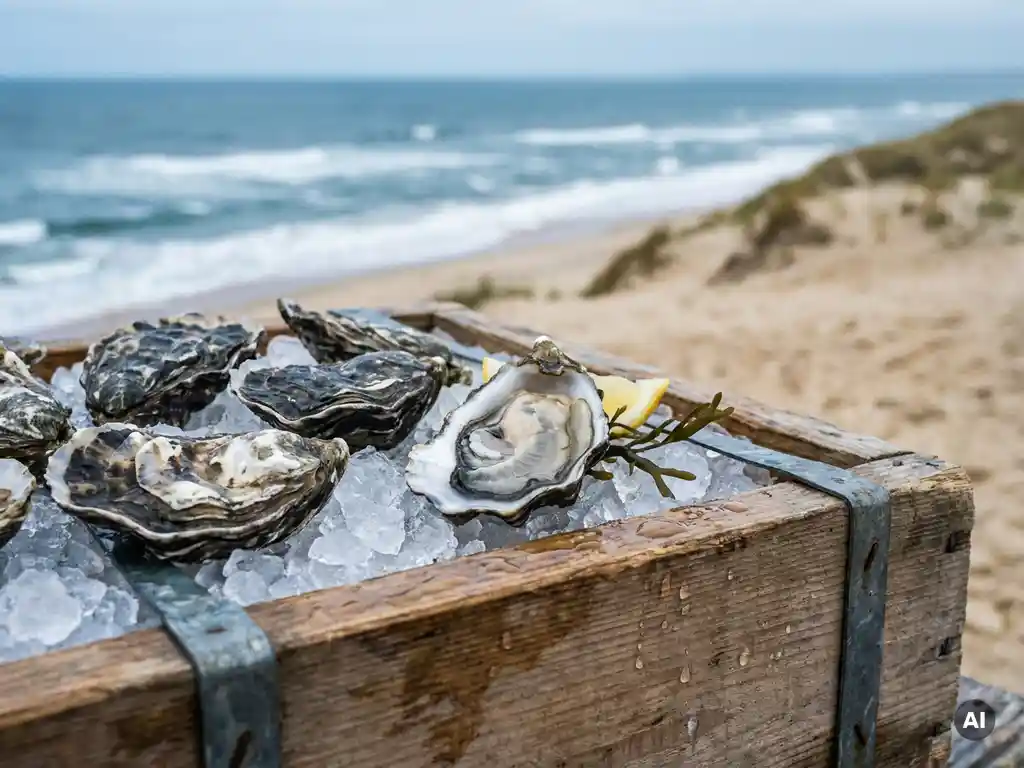
The best oysters in the world come from cold, clean coastal waters with a rich mix of fresh and salt water. Regions such as Brittany, Normandy, the Irish coast, the Zeeland Delta, and the Japanese coastline are considered the most renowned areas of origin. The taste, texture, and quality of an oyster are strongly determined by where it grows. In this article, we answer the most frequently asked questions about oyster origin, varieties, quality, and purchasing.
Which regions are known for the best oysters in the world?
The best-known oyster regions in the world are Brittany and Normandy in France, the west coast of Ireland, and the Zeeland Delta in the Netherlands. Each of these areas combines clean water, the right temperature, and a unique mineral composition that gives the oyster its character.
France has traditionally been considered the epicenter of oyster farming. Regions such as Cancale, Marennes-Oléron, and the Baie de Quiberon supply oysters that are appreciated worldwide for their complex flavor. The Irish west coast, particularly Galway and Donegal, produces oysters in particularly cold and clear Atlantic waters, resulting in a fresh, briny taste.
The Zeeland Delta has a strong reputation of its own. Yerseke is the center of Dutch oyster farming, where mussels and oysters have been cultivated for generations in the rich, tidal waters of the Oosterschelde. The combination of fresh river water and salty seawater creates a characteristic flavor that distinguishes the Zeeland oyster.
What makes an oyster high quality?
A high-quality oyster is recognizable by a closed, intact shell, a full and firm interior, clear liquid, and a fresh, salty aroma. In addition, origin, cultivation time, and processing method play a decisive role in the final quality.
Cultivation time is an underestimated factor. Oysters that grow longer in clean water develop a deeper flavor and a firmer texture. Some premium oysters are further matured after the initial cultivation in special tanks, known as claires, where they develop a milder, nutty flavor.
Traceability also plays a role in quality. An oyster whose origin can be fully traced offers greater guarantees regarding the farming context, water quality, and the processing chain. For professional buyers, this is increasingly a decisive criterion when selecting suppliers.
What is the difference between Fines and Spéciales?
An important distinction within commercial oyster categories is that between Fines and Spéciales. Fines are generally less fleshy and more affordably priced. Spéciales are fuller, fleshier, of higher quality, and often more expensive. This distinction is relevant for both sourcing and presentation to end customers.
Fines
Fines are slimmer in shape and have a distinctly salty, fresh taste. The Fine de Claire is a well-known representative of this category: an oyster matured in a claire, a shallow cultivation basin in the Charente-Maritime. The elongated, undulating shape is often associated with this type of oyster, although external characteristics are not an absolute measure.
Specials
Spéciales are fuller and meatier, with a richer, creamier flavor. The Spéciale de Claire and the Gillardeau fall within this category. A rounder, fuller shape is often associated with Spéciales, but here too, appearance is merely an indication. Zeeland oysters are subdivided into Creuses and Flat oysters, two different types that are separate from the classification into Fines and Spéciales.
Why do oysters from different regions taste so different?
Oysters taste different by region because you literally taste the water in which they grow. This phenomenon is called merroir, a concept analogous to the wine concept of terroir. Factors such as salinity, water temperature, current, algae composition, and soil type together determine the taste of each individual oyster.
An oyster from the Atlantic coast of Ireland filters large quantities of cold, clear ocean water daily, thereby developing a distinctly salty, iodine-rich flavor. An oyster from Marennes-Oléron in France grows in basins where a specific green algae, Navicula ostrearia, is present. This algae gives the oyster a green tint and a nutty, mild flavor.
In the Zeeland Delta, the interaction between the Rhine, the Meuse, and the North Sea creates a unique salinity level and a rich food source. Oysters raised here have a distinct character that is recognizable to connoisseurs.
What are Gillardeau oysters and why are they special?
Gillardeau oysters are an exclusive farming brand from the Charente-Maritime in France, originating from the family business Maison Gillardeau. They are considered one of the most refined oysters in the world due to their exceptional taste, consistent quality, and long cultivation process of four to five years.
What sets Gillardeau oysters apart is the combination of a rigorous selection process, multiple cultivation sites along the Atlantic coast, and a unique maturation method. The oysters are moved multiple times during their growth, resulting in a firmer shell and a full, creamy interior with a complex flavor.
Every Gillardeau oyster features a recognizable logo on the shell as proof of authenticity. This makes counterfeiting difficult and guarantees the buyer that they have an original product in their hands. Gillardeau oysters are served in the best restaurants in the world and are considered a benchmark for oyster quality.
How do you recognize a fresh oyster when buying one?
You can recognize a fresh oyster by a tightly closed shell, a fresh sea smell without an ammonia odor, sufficient clear liquid inside, and a firm, glossy interior that is not shriveled. Oysters that are open and do not respond to a tap are no longer suitable for consumption.
When purchasing, these are the most important features to look out for:
- Closed shell: a living oyster keeps its shell closed; if it is open, it is dead.
- Weight: a fresh oyster feels heavy due to the moisture it retains
- Scent: smells like the sea, fresh and salty, never like ammonia or rotten fish
- Liquid: after opening, sufficient clear liquid must be present
- Color and texture: the meat is glossy, plump, and has a uniform color without brown or dry spots.
Always store oysters chilled, preferably between 4 and 8 degrees Celsius, with the rounded side down to retain moisture. Fresh oysters are generally good for a few days after purchase, provided they are stored correctly.
How Adri & Zoon helps with the purchase of oysters
For professional buyers seeking high-quality oysters with a reliable provenance, Adri & Zoon a trusted partner. As a family business from Yerseke, the heart of Zeeland's oyster culture, Adri & Zoon in-depth product knowledge with a wide range of shellfish.
What sets Adri & Zoon apart for oyster buyers:
- Official Gillardeau dealer in the Benelux since 2019, for access to one of the most exclusive oysters in the world.
- Strong traceability: the origin and route of every product are fully traceable, so you can tell your own customers the story behind the oyster.
- Specialized product knowledge: Adri & Zoon has extensive expertise regarding oyster varieties, origin, and quality, and actively collaborates with professional clients.
- Wide assortment: from Zeeland Flat oysters and Creuses to premium Spéciales and Gillardeau, as a one-stop shop for fish, crustaceans, and shellfish.
- Custom packaging and delivery: products are packed according to the customer's wishes, using our own transport.
Would you like to know more about the oyster selection, or are you curious which varieties best suit your clients? Contact Adri Adri & Zoon for personal advice, or read more about the story behind the company.