

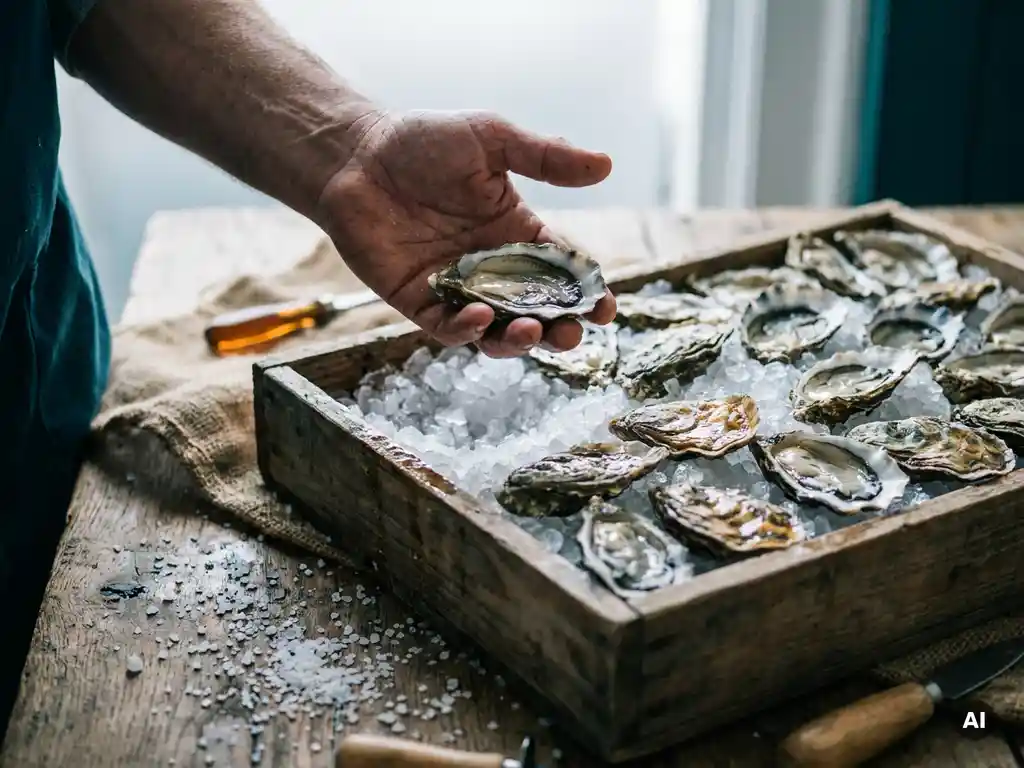
You choose a reliable oyster supplier based on quality consistency, transparency regarding origin, and the capacity to supply you structurally as a fishmonger. The supplier must not only be able to deliver the right varieties but also demonstrably know where their oysters come from and how they are farmed. The questions below will help you make the right choice step by step.
What to look for regarding the quality of oysters?
When assessing oyster quality, you look for freshness, shell integrity, aroma, plumpness, and liveliness. A fresh oyster smells of the sea, is firmly closed or closes upon touch, and has a full, juicy interior. Quality begins with the origin and farming method, and is determined by every link in the subsequent chain.
Oysters that have been in transit for a long time or have been stored poorly lose moisture and flavor. When purchasing, pay attention to the expiration date and the packaging date, but also to the storage conditions during transport. Oysters must be kept cool, preferably with the hollow side down so that they remain in their own juices.
The farming location has a major influence on taste and texture. Oysters from Zeeland, Brittany, or Ireland each have their own distinct flavor profile due to the composition of the seawater, currents, and food availability. A supplier who can explain these nuances provides you, as a fishmonger, with the knowledge to better serve your customers.
What is the difference between an oyster farmer and an oyster wholesaler?
An oyster farmer cultivates oysters himself, from seed to a ready-to-sell product. An oyster wholesaler purchases oysters from multiple growers and supplies them to professional customers such as fish shops, restaurants, and caterers. A wholesaler thereby offers a broader assortment and more flexibility, while a grower possesses more in-depth knowledge of his own product.
For a fish shop, a wholesaler is often the more practical choice. Through a single supplier, you have access to various species and origins without having to purchase from multiple breeders yourself. Moreover, a wholesaler can handle larger volumes, deliver more flexibly, and offer additional services such as custom processing and packaging.
A grower can be interesting if you want to highlight a specific product, such as a premium oyster from a well-known location. In that case, a direct relationship with the grower adds value to your narrative for the customer. In practice, the best wholesalers work closely with regular growers, ensuring you get the best of both worlds.
How do you check if an oyster supplier is reliable?
A reliable oyster supplier is certified, transparent about origin, consistent in quality, and accessible in case of problems. Check whether the supplier possesses the required food safety certificates, whether they can demonstrate the origin of their oysters, and whether there are clear agreements regarding delivery, complaints, and returns.
When dealing with a new supplier, always ask about the traceability of the product. Can they indicate from which farming area the oysters come, who the grower is, and what route the product has taken? Suppliers who cannot answer these questions offer insufficient certainty for you and your customers.
References and reputation count too. A supplier who has been supplying companies similar to yours for years has proven that they can perform consistently. If possible, visit the location or request samples before entering into a long-term partnership. Consistency across multiple deliveries is a better indicator than a single good trial delivery.
Which oyster species are most suitable for a fish shop?
For a seafood shop, the European flat oyster (Ostrea edulis) and the giant oyster (Crassostrea gigas) are the most common choices. The giant oyster is the best-selling due to its robust flavor, longer shelf life, and wide availability. The European flat oyster is more exclusive, has a finer, nutty flavor, and appeals to a more specialized clientele.
Within the creuses, a distinction is made between Fines and Spéciales. Fines are generally less meaty and more affordably priced. Spéciales are fuller, meatier, and of higher quality. Premium varieties such as the Gillardeau fall under the Spéciales and are distinguished by a particularly firm texture, a rich flavor, and a high degree of consistency. They are more expensive but attract customers who consciously choose quality. Ideally, a well-stocked fish shop offers both an accessible entry-level option and a premium choice.
In addition to variety, size also plays a role. Oysters are classified into sizes, where a lower size designation indicates a larger size. Size 3 is a common, accessible size for consumers who eat oysters themselves; sizes 2 and 1 are more often used in the hospitality industry or for special occasions. Ensure that your supplier can provide multiple sizes so that you can respond flexibly to demand.
How does traceability work for oysters in practice?
Traceability for oysters means that for every product, it is demonstrable where it was cultivated, when it was harvested, through which links it was transported, and under what conditions it was stored. In practice, this is recorded via labels, batch codes, and digital systems that document every step in the chain.
European legislation requires producers and traders to maintain certain traceability information, but the level of detail varies significantly by supplier. Some suppliers can only indicate the direct origin; others can reconstruct the entire route from cultivation plot to delivery to your store.
For a fish shop, good traceability is not only a legal obligation but also a commercial argument. Customers are increasingly asking questions about origin and sustainability. A supplier who provides you with concrete information about the farming location, breeder, and farming method gives you the story you can tell at the counter. That sets you apart from shops that can only offer a price and a product name.
When is it smart to use multiple oyster suppliers?
Using multiple oyster suppliers is smart when you want to expand your assortment breadth, supply reliability, or price competition. A single supplier can be vulnerable to shortages, seasonal fluctuations, or logistical problems. A second supplier offers a safety net and strengthens your negotiating position.
At the same time, diversification also has disadvantages. More suppliers mean more administration, higher minimum order quantities, and lower volume per supplier, which can weaken your discount position. For smaller fish shops, it is often more efficient to choose one strong main supplier capable of providing a wide range of oysters, supplemented by possibly one specialized grower for a premium product.
A good middle ground is to work with a wholesaler as a fixed base and engage an additional supplier for specific demand or seasonal peaks. This way, you keep the purchasing relationship manageable without being dependent on a single party for your entire oyster needs.
How Adri & Zoon helps with sourcing oysters
Adri & Zoon is a wholesaler of fish, crustaceans, and shellfish with over forty years of experience and an extensive specialization in oysters. As an official Gillardeau dealer in the Benelux and with its own network of reliable growers, Adri & Zoon professional fish shops a solid foundation for their oyster purchasing. This makes Adri & Zoon a suitable oyster supplier for your fish business:
- Wide assortment of oysters featuring both standard creuses and premium varieties such as Gillardeau, in multiple sizes.
- Strong traceability: the origin and route of every batch are demonstrable, so you can tell your customers a concrete story.
- Specialized product knowledge of oysters, including farming locations, taste differences, and seasonal patterns.
- Custom packaging and delivery, tailored to your store's needs.
- Own transport for reliable, refrigerated delivery
- One-stop shop: in addition to oysters, also a full range of fish and shellfish.
Adri & Zoon actively collaborates with professional buyers. Whether you are looking for a reliable supplier for your core assortment, want advice on which oyster varieties suit your clientele, or want to know more about traceability and origin: the team is ready to help. View the story behind the company or contact us directly for a no-obligation discussion about your purchasing needs.