

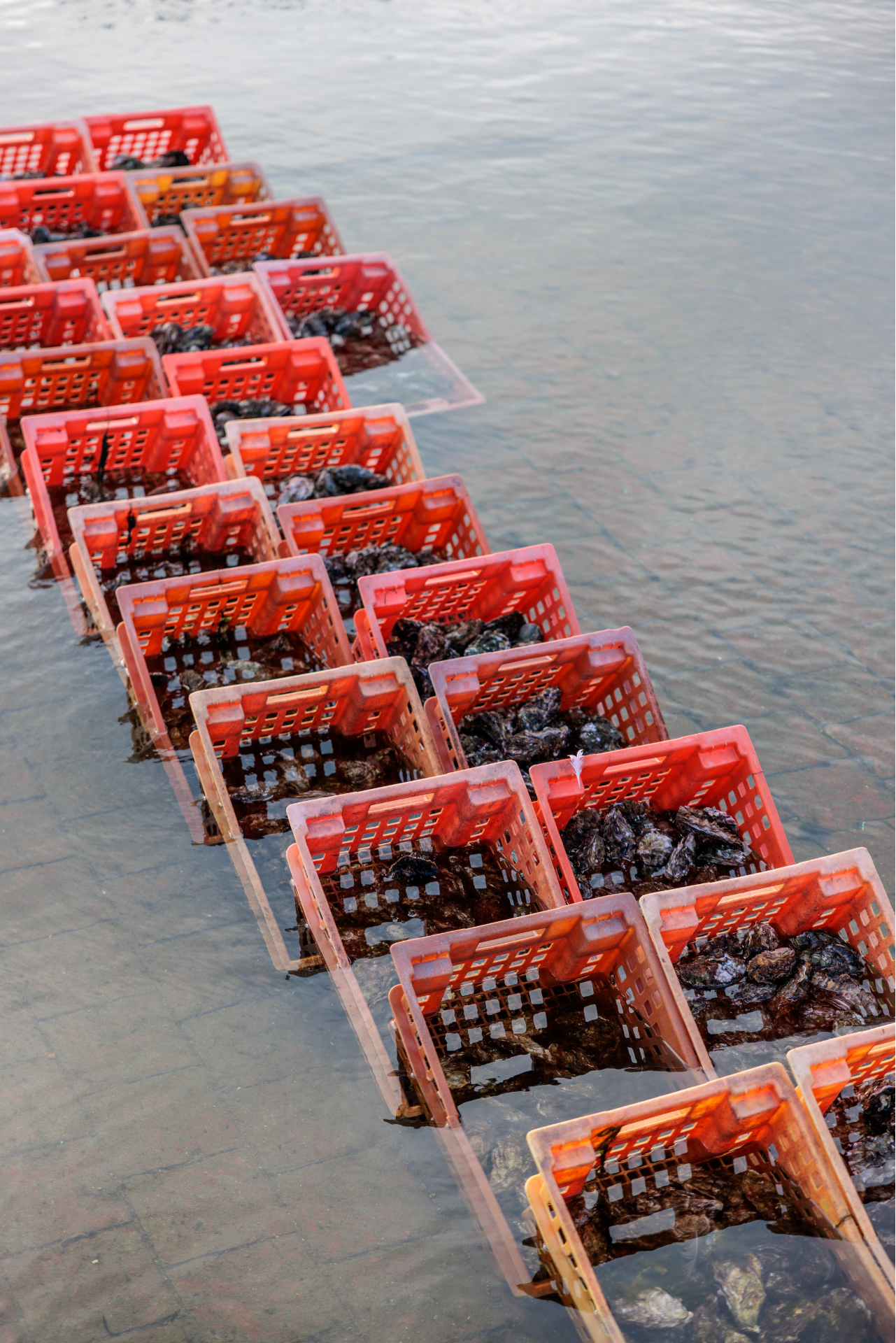
There are two main types of oysters commercially cultivated worldwide: the creuse (hollow oyster) and the flat oyster. Within these two families, there are dozens of varieties, each with its own flavor profile, origin, and quality class. The differences between oyster species are determined by factors such as water temperature, salinity, cultivation time, and farming method. This article answers the most frequently asked questions about oyster species, flavor differences, and classification by size and weight.
How many oyster species are there worldwide?
Worldwide, there are more than a hundred oyster species, but only a handful are commercially farmed on a large scale. The two most common species in Europe are the Crassostrea gigas (Japanese oyster, also known as the creuse) and the Ostrea edulis (European flat oyster). Both species have countless regional varieties with their own names and quality characteristics.
Outside Europe, the Pacific oyster and the Virginia oyster are also well-known. In practice, however, the European market relies largely on the creuse and the flat oyster, supplemented by a small number of premium varieties such as the Belon and the Gillardeau. The origin of an oyster, from the Atlantic coast of France to the waters of Zeeland, has a major influence on the final flavor profile.
What is the difference between a creuse and a flat oyster?
The main difference between a creuse and a flat oyster lies in their shape, taste, and cultivation method. The creuse has an elongated shell and a mild, slightly sweet flavor profile. The flat oyster has a round, flat shell and is known for a more intense, pronounced, and sometimes bitter taste with a stronger salty finish.
The creuse is by far the most farmed oyster in Europe and is available year-round. The flat oyster is rarer, more labor-intensive to cultivate, and therefore more expensive. Flat oysters are often associated with a more complex taste experience and are popular among connoisseurs. Creuses are more accessible and therefore suitable for a wider audience, from restaurant guests to novice oyster enthusiasts.
What determines the taste of an oyster?
The taste of an oyster is primarily determined by the environment in which it grows, a concept referred to in the oyster world as merroir, comparable to terroir in wine. Factors such as water salinity, water temperature, available nutrients, and currents together determine the oyster's final flavor profile.
Oysters from cold, rough waters with high salinity, such as those off the Atlantic coast of Brittany or Ireland, generally taste more intense and saltier. Oysters from calmer, warmer waters, such as those in the Zeeland Delta, often have a milder, slightly sweet taste. In addition, the cultivation period and the maturation period play a role: oysters that are kept longer in special basins, known as claires, develop a richer, nuttier flavor. The type of algae on which the oyster feeds also contributes to the complexity of the flavor.
What makes a Gillardeau oyster special?
The Gillardeau oyster is one of the most renowned premium oysters in the world. What makes it special is the combination of an exclusive farming concept, an exceptionally long cultivation process, and controlled origin. Gillardeau oysters are farmed for a minimum of four years, twice as long as an average creuse, resulting in a firm, meaty oyster with a complex, nutty flavor and a long finish.
The Gillardeau family business from Charente-Maritime in France has developed a closed cultivation system in which every stage of cultivation is controlled internally. As a result, the quality is exceptionally consistent. The oyster is characterized by its thick shell, high meat content, and a flavor profile that is salty, creamy, and slightly sweet at the same time. The Gillardeau is recognizable by the engraved letter G on the shell, which also protects it against counterfeiting.
Which oyster suits which season?
Oysters are in principle available all year round, but their quality and taste vary by season. The traditional rule of thumb that oysters should only be eaten in months with an R is largely outdated for modern farmed oysters. Nevertheless, the season does indeed influence the taste and texture of the oyster.
During the summer months, oysters spawn, causing the texture to become milkier and softer. Some enthusiasts appreciate this, but for those who prefer a firm, compact oyster, the autumn and winter months are more ideal. Triploid oysters, a sterile variety that does not spawn, are actually suitable for consumption in the summer and offer consistent quality throughout the year. Flat oysters are at their best in the winter and are traditionally served from September to April.
How are oysters classified by size and weight?
Oysters are classified based on weight, with the numbering varying by species. For creuses , the scale runs from number 5 (small, approximately 30 grams of meat) to number 0 or 00 (very large, more than 150 grams of meat). The lower the number, the larger the oyster. A similar numbering is used for flat oysters , but the classification runs from 000 (large) to 6 (small).
For the hospitality and foodservice industry, sizes 2 and 3 are the most common for creuses: size 3 is an accessible, easy-to-present oyster, while size 2 is slightly larger and is also widely used. Size 1 and larger are more often used for special occasions or as a showpiece on a seafood platter. It is important to note that the numbering refers to the total weight including the shell, not the weight of the meat alone.
How Adri & Zoon helps with the purchase of oysters
For professional buyers working with oysters, reliable knowledge of species, origin, and quality is indispensable. Adri & Zoon is a specialized wholesaler of fish, crustaceans, and shellfish that has been operating from Yerseke, the heart of Zeeland's oyster culture, since 1983. The company possesses in-depth product knowledge, particularly regarding oysters, and is the official Gillardeau dealer in the Benelux.
What sets Adri & Zoon apart for professional clients:
- Wide range of oysters from creuses to flat oysters and premium varieties such as Gillardeau, as part of a complete range of shellfish.
- Strong traceability: the origin and route of each product can be easily traced, so you can tell your customers the story behind the oyster.
- Specialized product knowledge that helps you choose the right oyster for your specific application, season, and target group.
- Thinking along with the customer: not just supplying products, but offering solutions that meet your needs as a professional buyer.
- Own transport for reliable delivery with quality control all the way to the destination
Would you like to know more about the oyster selection, or are you curious which varieties best suit your concept? Contact Adri Adri & Zoon for personal advice, or read more about the story behind the company.