

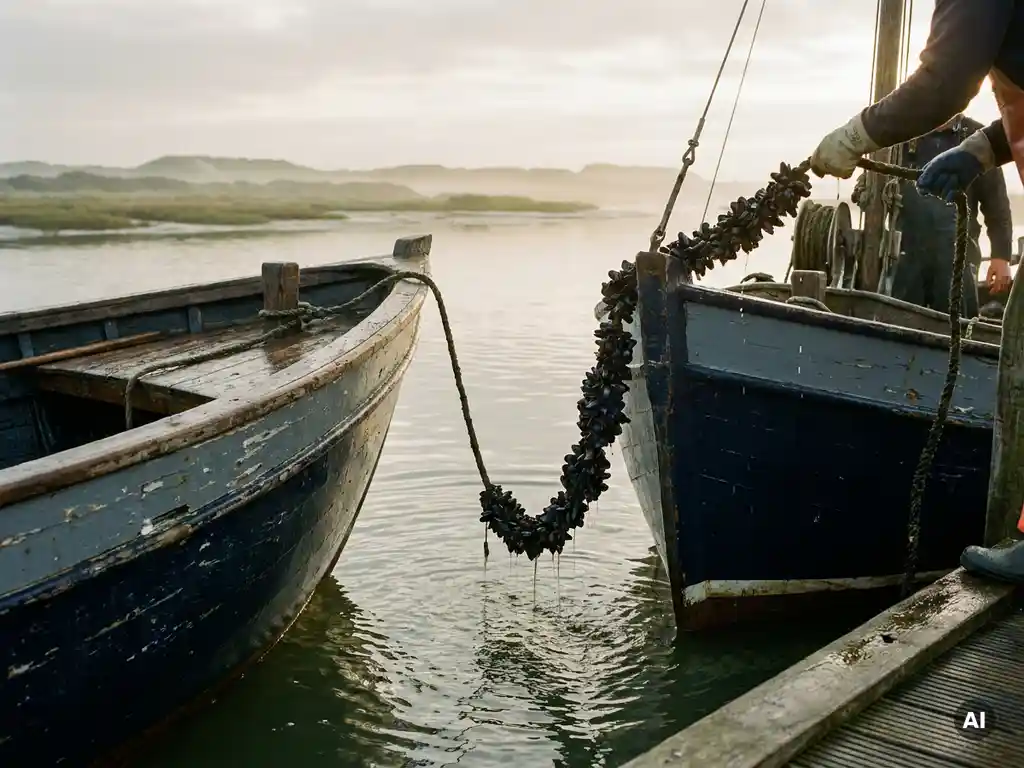
Mussels are cultivated by collecting mussel spat from the sea and growing it to consumption size on plots on the seabed. Cultivation takes an average of two to four years, depending on the location and conditions. The harvest is carried out using specialized vessels that mechanically retrieve the mussels from the seabed. This article explains all the steps from mussel farming to plate.
Where are mussels farmed in the Netherlands?
Mussels are primarily cultivated in the Netherlands in the Oosterschelde and the Wadden Sea. These are two sheltered, nutrient-rich bodies of water that offer ideal conditions for mussel farming. The waters of Zeeland, and the Oosterschelde in particular, are known for the excellent quality of the mussels produced there.
The Zeeland mussels from Adri & Zoon grow from start to finish in Zeeland waters, at the mouth of the Oosterschelde. The Oosterschelde has a constant water temperature, a high salinity, and a rich supply of plankton, which greatly promotes the growth and flavor of mussels. As a result, mussels from Zeeland enjoy an excellent reputation, both in the Netherlands and abroad.
How does mussel farming start?
Mussel farming begins with the collection of mussel spat: tiny mussel larvae that naturally float in the water and attach themselves to hard surfaces or to each other. Growers collect this spat using special ropes or nets, or gather it from the seabed. This spat forms the basis of the entire mussel industry.
After harvesting, the mussel spat is transferred to cultivation plots on the seabed. These plots are comparable to fields on land: growers hold an official permit for a specific section of the seabed and are responsible for its management. On the plots, the mussels attach to each other and continue to grow on the food supplied by the seawater, primarily algae and phytoplankton. The growers do not need to feed the mussels; the sea does the work.
How long does it take for mussels to be ready for harvest?
Mussels are ready for harvest after an average of two to four years. The exact duration depends on the water temperature, the availability of food, and the location of the cultivation plot. In nutrient-rich, well-flowing waters such as the Oosterschelde, mussels can grow faster than in colder or less nutrient-rich areas.
A mussel intended for consumption typically has a shell length of at least five centimeters. Growers regularly assess the growth and condition of the mussels on their plots. When the mussels have reached the correct size and meat content, they are ready for harvest. The meat content, also known as the meat-to-shell ratio, is an important quality indicator: a good mussel has a full, firm piece of meat inside the shell.
How are mussels harvested from the seabed?
Mussels are harvested using specialized mussel trawlers equipped with a trawl net, known as a mussel dredge. This net is dragged across the bottom of the cultivation plot and scoops up the mussels. On board, the mussels are rinsed and roughly cleaned before being transported to the processing location.
The harvest is a precise process. Growers plan the harvest carefully so that it does not take place too early or too late. Mussels harvested too early are not yet full enough; mussels harvested too late can deteriorate in quality. After collection, the mussels are processed as quickly as possible to guarantee freshness. Modern mussel trawlers are equipped to sort and rinse the mussels directly on board, which benefits the quality.
What happens to mussels after the harvest?
After harvesting, mussels are sent to a mussel processing plant, where they are cleaned, sorted, and packaged. During processing, dead mussels, shells, and other bycatch are removed. The live mussels are washed and then sorted by size and quality before being packed for transport.
An important part of the post-harvest phase is rinsing in clean seawater. This process, also known as depuration or purification, ensures that any impurities are removed from the mussels. After purification, the mussels are packaged, usually in nets, bags, or special leak-proof plastic containers, and delivered as quickly as possible to wholesalers, restaurants, and shops. The entire chain from harvest to delivery is aimed at getting the mussels to the consumer as fresh as possible.
When is mussel season and when are mussels at their best?
The Zeeland mussel season generally runs from June through February, depending on quality and conditions. The first mussels of the new season are already available in the summer. Mussels are at their best in the autumn and early winter, when they are plump and flavorful after a summer of intensive feeding. Outside the Zeeland season, mussels from other countries of origin may be offered.
During the summer months, mussels spawn, which can make them temporarily lean and less flavorful. After the spawning period, the mussels recover quickly and build up their meat content again. The autumn months remain the period when mussels naturally have the highest meat content. For professional buyers, it is important to take this seasonal variation into account when compiling the menu or assortment.
How Adri & Zoon helps with mussels, crustaceans, and shellfish
For professional buyers seeking high-quality mussels and other shellfish, Adri & Zoon a complete solution. As a family business from Yerseke, has possessed Adri & Zoon deep-rooted knowledge of mussel farming and the Zeeland fishery since 1983. This knowledge translates into a rigorous selection based on quality and a reliable, traceable supply.
Adri & Zoon sources Zeeland mussels from mussel farm Neeltje Jans. The mussels are harvested to order from their own cultivation parks and bear the Zeker Zeeuws quality mark.
What sets Adri & Zoon apart for professional clients:
- Wide assortment: from fresh and frozen mussels to oysters, shrimp, and fish, all available from a single supplier as a one-stop shop.
- Strong traceability: the origin and route of every product can be accurately traced, so you can tell your customers the story behind the mussel.
- Product knowledge: Adri & Zoon possesses specialist in-house knowledge of shellfish and actively collaborates with clients on assortment and seasonal planning.
- Custom packaging: mussels and other products are packaged according to customer wishes, including environmentally friendly options.
- Own transport: with its own fleet of trucks, Adri & Zoon fresh and reliable goods to customers at home and abroad.
As a professional buyer, do you want to be sure of fresh mussels at the right time of the season, with the right quality and a clear story about their origin? Contact Adri Adri & Zoon and discover what the company can do for your purchasing.