

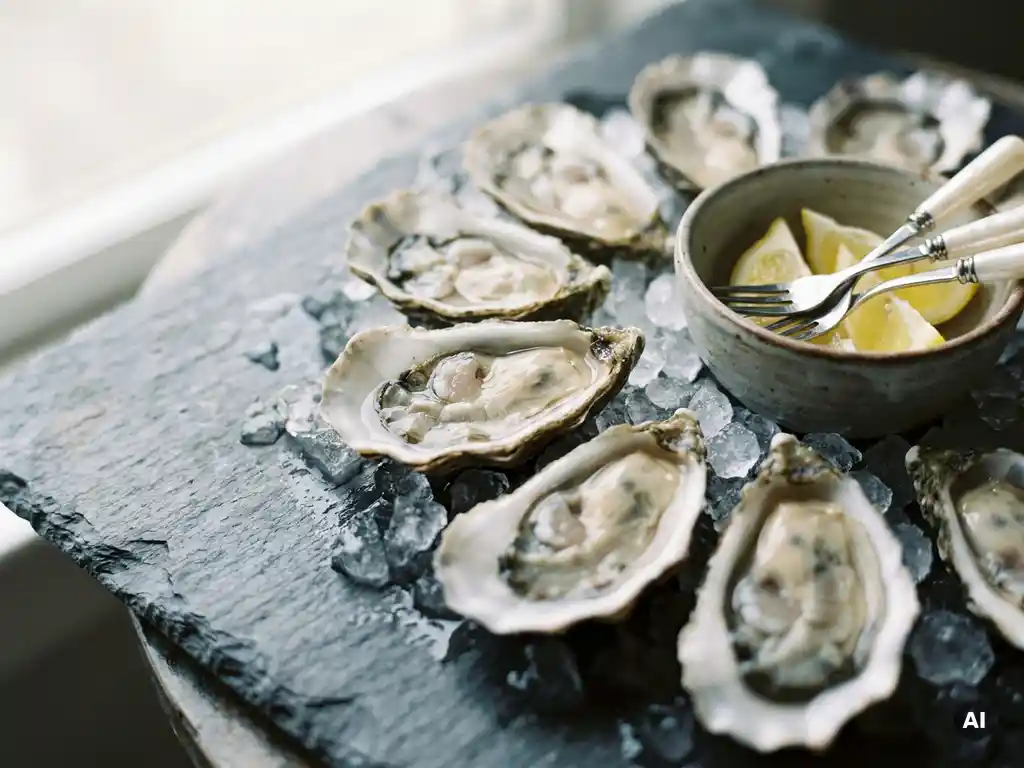
You can recognize fresh oysters by a closed or tightly closing shell, a fresh sea scent, clear liquid, and live meat that responds to touch. Quality oysters are always alive at the moment of consumption. Those who know what to look for buy with confidence and serve with certainty. The questions below help you check oyster quality step by step, from shell to taste.
How can you tell if an oyster is still alive?
A fresh oyster is always a live oyster. The most important sign is that the shell is closed or closes when you tap it. An oyster that is open and does not respond to touch or sound is dead and should not be consumed. Live oysters feel heavy because they still contain moisture.
If you tap the shell gently and it closes, the oyster is alive. If it remains open or feels noticeably light, that is a clear sign that the oyster is no longer fresh. Weight is a reliable indicator: a good oyster is full of its own seawater, also known as liqueur . That fluid is essential for both quality and taste.
How does a fresh oyster smell?
A fresh oyster smells of the sea: fresh, salty, and slightly iodine-like. That scent is a direct indication of good quality. If an oyster smells of ammonia, fish, or something rotten, it is no longer suitable for consumption. A neutral or inconspicuous smell can also be a sign that the oyster is losing its quality.
The typical sea scent of an oyster comes from its habitat and what it filters. Oysters cultivated or caught in clean, oxygen-rich water have a clear, pleasant aroma. Oysters from richer waters, such as those from certain Atlantic regions or Zeeland, may have a slightly more mineral or nutty scent. Always trust your nose: an unusual smell is rarely a good sign.
What does the appearance of the shell say about the quality?
The shell of a fresh oyster is intact, firm, and free of cracks or fissures. A damaged shell may indicate that the oyster was subjected to shocks or pressure during transport, which can affect the quality of the meat. The color and texture of the shell vary by species, but overall firmness is always a mark of quality.
A good shell seals well. You should not see large openings at the edge. In some species, such as the European flat oyster (Ostrea edulis), the shell is rounder and flatter; in the Japanese oyster (Crassostrea gigas), it is more wavy and elongated. The shape indicates the species, but not necessarily the quality. What to look out for, however, is that a shell that arrives already cracked or bruised does not adequately protect the meat and is a reason to refuse the oyster.
How do you check an oyster after opening it?
After opening, check three things: the liquid, the color of the meat, and the reaction to touch. A fresh oyster has clear to slightly milky liquid, glossy meat with a creamy white to gray-green color, and the meat retracts or wobbles when you put a drop of lemon juice or vinegar on it. That is proof that the oyster is still alive.
Cloudy, gray, or heavily discolored liquid is a bad sign. Meat that looks dry, dull, or grainy indicates an oyster that has lost its quality. Also pay attention to the smell immediately after opening: it should be fresh and salty, not sour or musty. Professional buyers and chefs always check oysters for all these points together, because a single signal can sometimes be misleading on its own.
What is the difference in quality between farmed and wild oysters?
Farmed and wild oysters differ in taste, consistency, and availability, but not necessarily in quality. Farmed oysters grow under controlled conditions, ensuring a more consistent size, taste, and availability year-round. Wild oysters depend on nature and therefore have a more pronounced, complex flavor that can vary significantly by season and location.
Farmed oysters
Farmed oysters are raised in controlled environments, such as oyster beds or suspended cultures in the sea. Because growers monitor the conditions, the quality is predictable and stable. The Japanese oyster is the most farmed species worldwide and is known for its mild, buttery flavor. Well-known origins include Zealand, Brittany, and Ireland, each with its own flavor profile due to differences in water temperature, salinity, and food availability.
Wild oysters
Wild oysters grow on natural oyster beds without human intervention. They are less uniform in shape and size, but often have a deeper, more mineral flavor. The common oyster (Ostrea edulis) is the best-known wild species in Europe. Due to overfishing and disease, populations have declined sharply, making wild oysters rarer and more expensive. For professional kitchens, it is important to know where wild oysters come from so that seasonality and availability can be accurately assessed.
How do you store oysters so they stay fresh?
Store oysters in the refrigerator at a temperature between 2 and 8 degrees Celsius, with the convex side of the shell facing down to retain moisture. Cover them with a damp cloth or seaweed and ensure ventilation. Never store oysters in sealed plastic bags or under fresh water, as this kills them.
Fresh oysters, if stored properly, can be kept for three to five days after delivery, provided they arrived alive. Check daily that all oysters remain closed and remove any dead ones immediately. For professional kitchens, a consistent supply frequency and good temperature control throughout the chain are crucial to guarantee quality right down to the plate. The shorter the time between sea and plate, the better the taste and texture.
How Adri and Son helps with sourcing fresh oysters
For professional buyers who want to be certain of the quality of their oysters, the origin and expertise of the supplier make all the difference. Adri en Zoon is the official Gillardeau dealer in the Benelux and possesses in-depth specialist knowledge of oysters: from varieties and origin to taste profile and storage. They actively share this knowledge with their customers, so that you too can properly inform your own clients.
What sets Adri en Zoon apart for professional oyster buyers:
- Strong traceability: the origin and journey of every oyster are easily traceable, including the story behind the product.
- Wide assortment: in addition to oysters, also mussels, shellfish, and fish from one supplier.
- Thinking along with the customer: no standard solution, but tailored to the specific needs of your company.
- Own transport: direct control over delivery throughout Europe, safeguarding the cold chain.
- Official Gillardeau dealer in the Benelux: access to one of the most renowned oyster brands in the world
View the full range of shellfish or read more about Adri en Zoon's approach. Professional clients can order directly via the webshop or contact us for personal advice on the oyster selection that suits your business.