

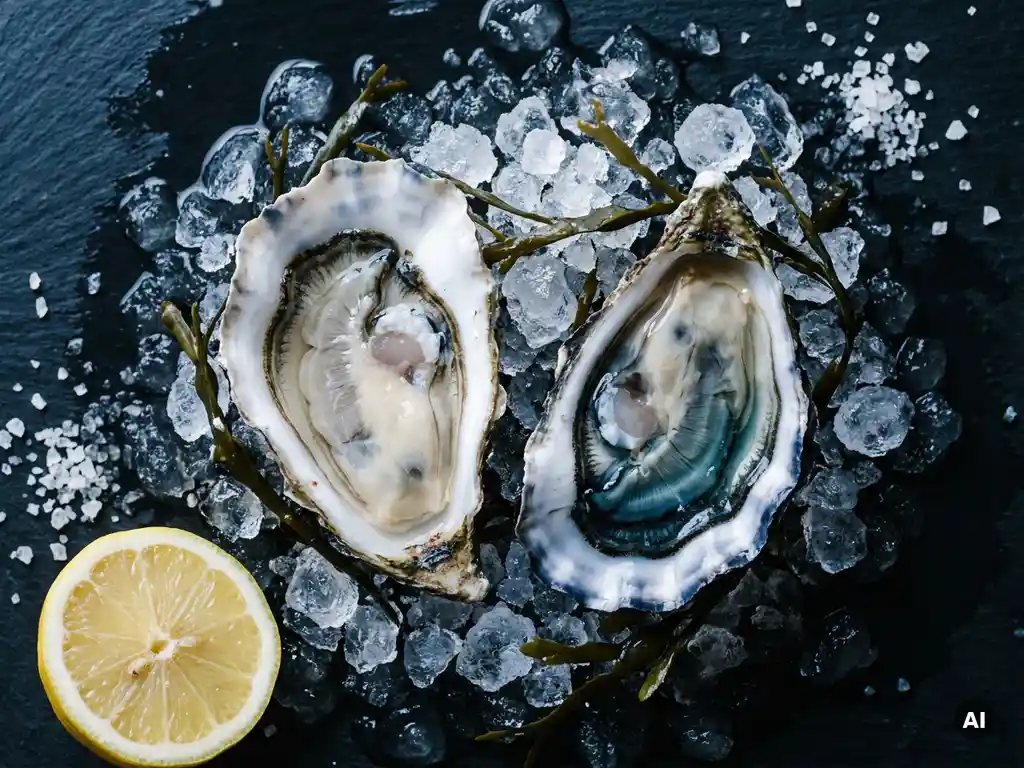
The difference between a flat and a hollow oyster lies in the shell shape, the meat, and the taste. Flat oysters have a round, flat shell and a briny, complex flavor with a pronounced iodine note. Hollow oysters have a deeper, bowl-shaped shell and a milder, creamier taste. For professional kitchens, knowing this difference is essential when compiling an oyster menu or a seafood platter. The questions below provide a complete picture of both oyster types.
What types of oysters are available?
The two main types of oysters available in Europe are the flat oyster (Ostrea edulis) and the hollow oyster (Crassostrea gigas). The flat oyster is a native European species that is relatively rare today. The hollow oyster is the most cultivated and sold species in the world and forms the basis of the modern oyster supply.
Within hollow oysters, commercial quality categories exist. The most important are the Fines and the Spéciales. Fines are generally slimmer in shape and less fleshy. Spéciales are fuller, fleshier, and have a richer flavor. Well-known examples are the Fine de Claire, the Spéciale de Claire, and the Gillardeau oyster, which belongs to the Spéciales. The Gillardeau is known as one of the most prized oysters in the world and is produced by a small, specialized grower in the Charente-Maritime.
In addition to French oysters, Irish and Zeeland hollow oysters are also popular. Zeeland creuses are a well-known hollow oyster from the Oosterschelde. Flat oysters come from Brittany, Ireland, and the waters of Zeeland, among others, although they are less readily available than hollow oysters.
How does the taste of a flat and a hollow oyster differ?
The taste of a flat oyster is more intense, mineral, and distinctly saltier than that of a hollow oyster. Flat oysters have a characteristic iodine note and a long-lasting, complex finish. Hollow oysters taste milder and creamier, with a slight sweetness that varies by origin and farming method.
For hollow oysters, the environment plays a major role in the development of the flavor. Oysters cultivated in the sea generally have a fresher, saltier taste. Oysters that are finished for a period in claire basins, such as the Fine de Claire or Spéciale de Claire, absorb the flavor of the brackish water and the algae present. This gives them a nutty or slightly buttery note.
Spéciales are generally fuller in flavor than Fines, due to their higher meat content and longer stay in the cultivation water. The Gillardeau oyster stands out for a particularly creamy, complex flavor that distinguishes it from other Spéciales.
What are the external differences between the two types of oysters?
The visual difference between a flat and a hollow oyster is immediately visible. The flat oyster has a round to oval shell that is almost equally flat on both sides. The hollow oyster has a deeper, cup-shaped lower shell with a relatively flat upper shell. The shell of hollow oysters is often wavy and elongated in shape, although this can vary by species and cultivation location.
The size of oysters is expressed in size numbers. Size 3 is a common, accessible size for the hospitality industry. Sizes 4 and 5 are smaller. Spéciales may have a rounder shell shape, while Fines more often have a more elongated, wavy shell. However, this is not an absolute rule: the shell shape is also influenced by the cultivation location and the method used.
How are flat and hollow oysters farmed?
Flat oysters are predominantly cultivated on the seabed, where they grow slowly in their natural environment. Hollow oysters are cultivated in various ways, depending on the desired quality and origin. The most commonly used methods are bagging on tables, hand baskets, and seabed culture.
Bags on tables and hand baskets
In the bag-on-table method, the oysters lie in mesh bags on metal racks in the intertidal zone. They are turned regularly so that they grow evenly and develop a beautiful shell shape. Hand baskets are used for oysters that require individual attention, such as the Gillardeau. Each oyster is selected and finished by hand, which contributes to the consistent quality and the characteristic round shape.
Seabed culture and claire finishing
In seabed culture, young oysters are sown on the seabed and harvested after a period of time. This gives the oyster a more robust shell and a distinct marine character. Some hollow oysters are transferred to claire basins—shallow saltwater ponds in the Charente-Maritime—after the cultivation phase. There, they refine their flavor due to the presence of microalgae. The longer an oyster stays in a claire, the more intense the flavor generally becomes.
Which oyster pairs best with which dish?
The choice between a flat or hollow oyster depends on the dish and the desired taste experience. Flat oysters are well-suited to a pure, unprocessed serving moment where the complex flavor takes center stage. Hollow oysters are more versatile and lend themselves to both raw serving and hot preparations.
For a classic oyster bar or a seafood platter, a combination of flat and hollow oysters offers the most variety. Fines are accessible to guests trying oysters for the first time, thanks to their milder taste. Spéciales, such as the Gillardeau, are suitable for a more luxurious offering and fit well on a menu for the higher segment. They are preferably served plain, without toppings that mask the taste.
Hollow oysters are also suitable for hot preparations, such as gratinating or poaching. Flat oysters are eaten almost exclusively raw, because the delicate flavor is lost when heated.
When are flat and hollow oysters at their best?
Flat oysters are best outside the summer months, from September through April. They spawn in the summer, which negatively affects the taste and limits availability. Hollow oysters are available year-round and of good quality, although the taste is generally slightly fuller and saltier during the colder months.
The months of November through February are considered a peak for both species. The cold water slows growth, resulting in a firmer, meatier oyster. This makes the winter months ideally suited for oysters on the menu, especially around the holidays when the demand for luxury shellfish increases sharply.
The rule that oysters may only be eaten in months with an ' r' is outdated. This restriction no longer applies to hollow oysters. Modern cultivation techniques and cold chains make it possible to supply high-quality hollow oysters all year round.
Purchasing oysters for professional kitchens via Adri & Zoon
Adri & Zoon is a fish wholesaler with extensive specialist knowledge of oysters. As an official Gillardeau dealer in the Benelux, the company supplies one of the most highly regarded Spéciales directly to the hospitality industry. In addition to Gillardeau, Adri & Zoon a wide range of oysters, including Fines and Spéciales from France, Ireland, and Zeeland.
What distinguishes Adri & Zoon for professional customers:
- Year-round availability of hollow oysters from reliable countries of origin
- Specialized product knowledge, so that chefs and buyers can properly inform their guests
- Strong traceability: the origin and route of every oyster can be easily traced
- Delivery with our own transport, six days a week from Yerseke
- Custom packaging, tailored to the customer's wishes
Are you a hospitality business or buyer looking to learn more about our oyster selection or the possibilities for your kitchen? Contact Adri Adri & Zoon for personalized advice.