

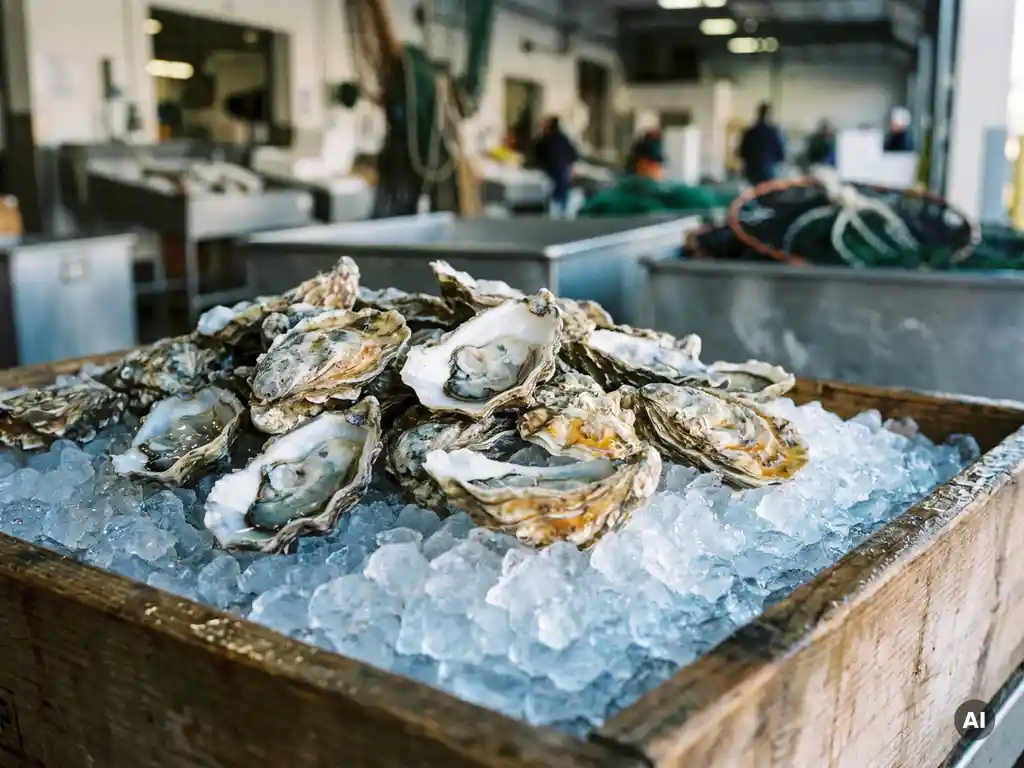
Some oyster varieties are available year-round, while others are tied to a specific season. Triploid oysters, including the well-known Gillardeau, are cultivated in a way that ensures they remain of stable quality even during the summer months. This article answers the most frequently asked questions about year-round oyster varieties, seasonality, and what this means for professional buyers.
Which oyster species have no seasonal restrictions?
Triploid oysters have no seasonal restrictions and are available year-round. These oysters possess three sets of chromosomes instead of two, meaning they do not waste energy on reproduction. They build up flesh throughout the year and maintain consistent quality even during the summer months.
The best-known examples of oyster varieties available year-round are triploid varieties of Crassostrea gigas, also known as the Japanese oyster or creuse. Brands such as Gillardeau and Fine de Claire Triploid fall into this category. In addition to triploid oysters, there are also deep-water oysters that are less sensitive to temperature fluctuations and therefore have a longer availability period. For professional buyers who require a stable oyster supply throughout the year, triploid varieties are the most reliable choice.
Why are some oysters only available seasonally?
Diploid oysters are seasonal because they use their energy for reproduction in the summer. During the spawning season, which falls in the warmer months from May to August, these oysters become milky and watery in taste. They are then less suitable for consumption and are temporarily not harvested by growers.
The rule of thumb that fishermen and oyster connoisseurs have followed for centuries is that oysters are at their best in months with an “r” in the name: September through April. This applies specifically to diploid oysters, such as many traditional flat oysters (Ostrea edulis) and certain varieties of the creuse. In the summer months, these varieties are less flavorful and also more difficult to store. Growers and traders take this into account in their planning and purchasing.
What makes Gillardeau oysters available all year round?
Gillardeau oysters are available year-round because they are triploid oysters that do not undergo a reproductive cycle. Furthermore, the Gillardeau cultivation method is exceptionally intensive: the oysters are manually selected, moved multiple times between cultivation sites, and individually inspected. This results in consistent quality, regardless of the season.
Gillardeau is a French family business that has been cultivating oysters in the Charente-Maritime for generations. Their oysters are known for their firm flesh, nutty flavor, and a longer shelf life than most other oyster varieties. The cultivation process takes four to five years per oyster, which is significantly longer than the average. This time investment translates into a product that performs consistently in terms of taste and texture, even during the summer months when many other varieties are out of season. For foodservice companies looking to offer a premium product year-round, Gillardeau is therefore a staple choice in their range.
How does the taste of oysters vary by season?
The taste of oysters varies seasonally due to changes in water temperature, food availability, and the reproductive cycle. In winter and early spring, oysters are firm, full-flavored, and slightly sweet. In summer, diploid oysters become softer and less pronounced in flavor due to spawning.
Specifically, the taste differences are as follows:
- Autumn and winter (September to February): Oysters are at their best. Firm flesh, pronounced salty flavor, sometimes with a slightly nutty or mineral character.
- Spring (March to April): Still of good quality, but the taste starts to become slightly milder as the water temperature rises.
- Summer (May to August): Diploid oysters become milky due to spawning. Triploid oysters retain their firmness and flavor profile.
For professional clients in the hospitality industry, it is important to be aware of this distinction. A menu offering oysters year-round requires a conscious choice for triploid varieties or an adjustment of the selection by season.
Where do oysters available year-round come from?
Year-round available oysters come mainly from France, Ireland, and the Netherlands. The origin partly determines the flavor profile: oysters from cooler waters are generally firmer and have a distinctly salty taste, while oysters from warmer coastal areas are milder.
French triploid oysters, such as Gillardeau from Charente-Maritime, are the best known. Irish oysters from the Atlantic Ocean are known for their freshness and briny taste. Dutch oysters are primarily cultivated in the Oosterschelde, a unique estuary that gives the oysters a characteristic flavor due to the mix of salt and fresh water. For professional buyers, origin is relevant not only for taste but also for traceability: the story behind the product is increasingly becoming a selling point for the end consumer.
Which oyster varieties are most suitable for foodservice?
For foodservice, triploid oysters are best suited due to their year-round availability, consistent quality, and longer shelf life. Furthermore, they are available in multiple sizes, offering flexibility for various applications, from appetizers to main courses.
The most commonly used oyster varieties in professional kitchens are:
- Creuse (Crassostrea gigas), triploid: Available year-round, firm flesh, suitable for serving raw as well as cooking.
- Gillardeau: Premium triploid oyster, belonging to the Spéciales, recognizable and valuable as a menu item, to be on the menu all year round.
- Flat oyster (Ostrea edulis): More seasonal, but sought after for its refined flavor profile. Suitable for restaurants that wish to leverage seasonality as a mark of quality.
- Fine de Claire: Belonging to the Fines, available in a triploid variant, finished in claire basins for a milder, creamier taste. Popular in bistro culture.
When choosing oysters for foodservice, practical factors play a role alongside taste: shelf life, delivery reliability, and size consistency. Triploid oysters score highly on all these points, making them the logical choice for kitchens that want oysters on the menu year-round.
How Adri & Zoon helps professional buyers with oysters
Adri & Zoon is the official Gillardeau dealer in the Benelux and supplies a wide range of oysters that is available all year round. As a wholesaler with deep roots in Yerseke, the heart of Dutch oyster culture, Adri & Zoon a strong network among growers with specialist product knowledge that goes beyond that of the average supplier.
What sets Adri & Zoon apart for professional clients who purchase oysters:
- Year-round supply: Triploid oysters, including Gillardeau, are available year-round via a stable supply line.
- Traceability: For every product, the origin and route are traceable, so that you as a buyer can tell the story behind the oyster to your customers.
- Specialized knowledge: Adri & Zoon possesses extensive knowledge of oyster varieties, seasons, and flavor profiles. This knowledge is actively shared with customers.
- Customization: Whether you want a fixed weekly delivery, need specific sizes, or are seeking advice on which type suits your concept, Adri & Zoon thinks along with you.
- One-stop shop: In addition to oysters, you can come to Adri & Zoon for mussels, shellfish, and a wide range of fish, so you can order everything from one supplier.
Would you like to know which oyster varieties best suit your concept, or are you curious about the possibilities for year-round supply? Contact Adri Adri & Zoon for personal advice, or view the full story behind the company to understand where the knowledge and passion come from.