

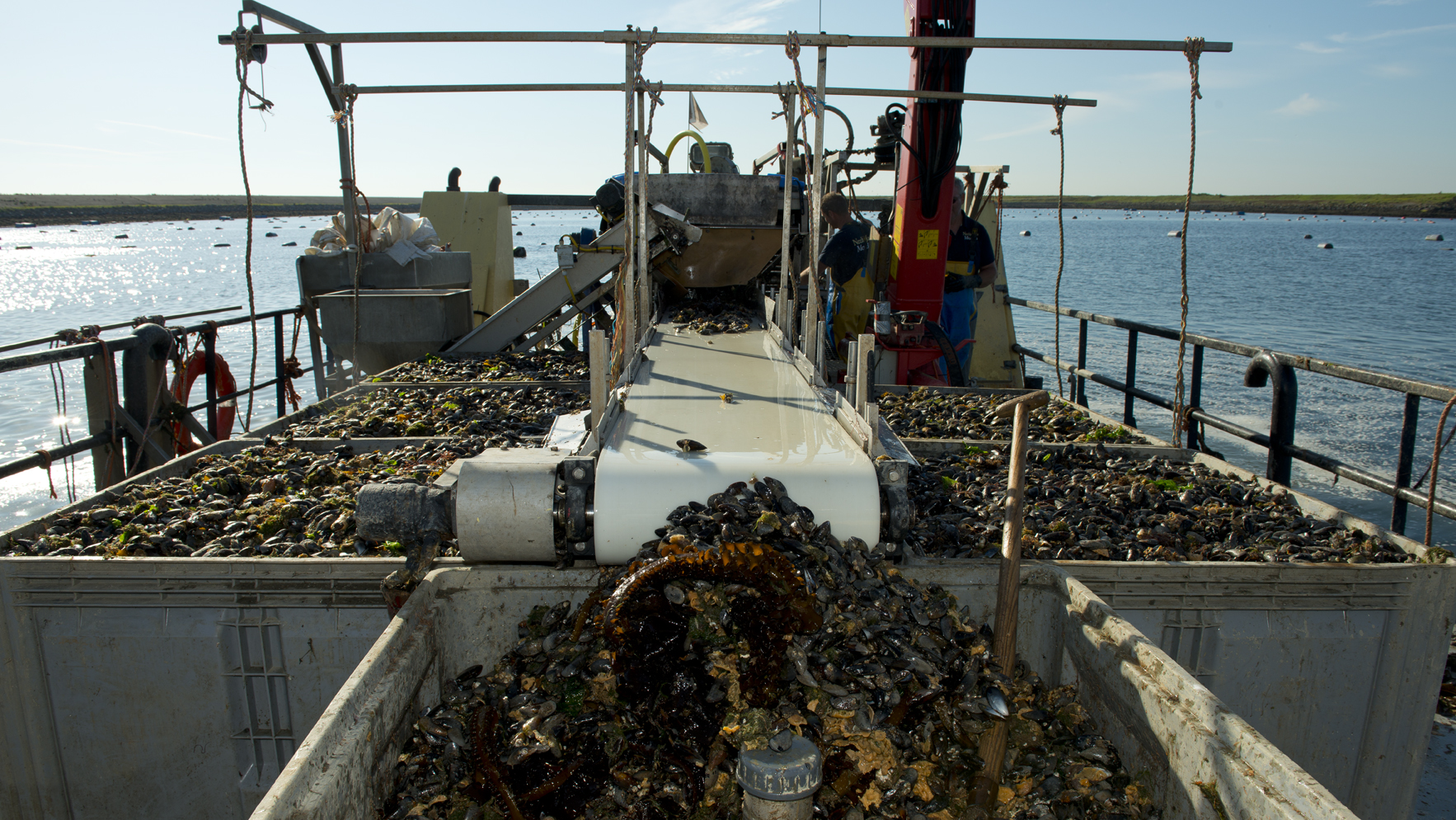
Zeeland mussels are cultivated on shallow plots in the Oosterschelde and the Grevelingenmeer, where the brackish water and rich nutrient environment provide ideal conditions. The cultivation process begins with the collection of mussel spat and takes an average of one and a half to two years before the mussels are ready for harvest. This article answers the most important questions about mussel farming in Zeeland, from spat to plate.
Where do Zeeland mussels come from?
Zeeland mussels come primarily from the Oosterschelde, the large estuary in the province of Zeeland. This water is known for its high salinity, strong tidal currents, and rich nutrient composition, which gives the mussels here a distinctly salty taste and firm texture. A smaller proportion is also cultivated in the Grevelingenmeer.
The mussels grow on cultivation plots: demarcated areas of seabed leased by mussel farmers. The location of these plots in the Oosterschelde determines the quality. Plots situated close to the flow of salty seawater yield mussels with more meat and a fuller aroma. The water in the Oosterschelde is relatively clean and is closely monitored, which contributes to the quality and safety of the harvest.
How is mussel spat collected and sown?
Mussel spat is collected from natural mussel beds in the North Sea or from so-called collection installations, where young mussel larvae attach themselves to ropes or nets. This spat, which is only a few millimeters in size, is subsequently transferred to the cultivation plots in the Oosterschelde and scattered on the seabed.
Sowing is carried out using special mussel vessels that distribute the seed evenly across the plot. The density at which the seed is scattered is important: too dense and the mussels compete for food; too sparse and the yield is disappointing. Mussel farmers make deliberate choices in this regard, based on years of experience and knowledge of local conditions.
In recent years, there has been increasing attention to mussel spat collected via so-called MZI systems, or mussel spat collection installations. This method is more sustainable than fishing spat from wild beds, because the natural mussel beds on the seabed are spared.
How long does it take for mussels to be ready for harvest?
After mussel spat has been sown on the cultivation plots, it takes an average of one and a half to two years for the mussels to reach the desired size for harvest. The exact duration depends on the water temperature, the availability of food, and the location of the plot.
Mussels grow by filtering algae and phytoplankton from the water. During periods of high algal growth, such as in spring and early summer, they grow faster. In winter, growth slows significantly. Growers closely monitor growth and may decide to move mussels to other plots in the interim, for example to give them more space or to allow them to mature in richer water.
How are mussels harvested from the cultivation plots?
Bottom-culture mussels are harvested using specialized mussel cutters equipped with trawl nets or special fishing equipment. The net is dragged across the seabed of the plot, and the mussels are brought on board. On board, they are rinsed, sorted by size, and cleared of loose shells and other bycatch.
After harvesting, the mussels go to a mussel processing plant, where they are washed, stored in seawater, and subsequently traded. Quality control plays a major role here: mussels that do not meet the size requirements or are damaged are filtered out. The freshness of the mussel after harvesting determines the final quality on the plate.
When is the mussel season in Zeeland?
The mussel season in Zeeland generally runs from June through February, depending on quality and conditions. The official season begins as soon as the quality of the harvest has been approved by the sector and the authorities. The first mussels of the season are in high demand and are also known as “new mussels” or “first mussels”.
In the months of March through May, mussels can be lean and fragile due to the spawning season, making them less suitable for consumption. Outside this closed season, Zeeland mussels are available almost all year round, although quality varies by period. The autumn months are generally considered the best time: the mussels are then large, plump, and flavorful due to the abundant algae growth during the summer months. Outside the Zeeland season, mussels from other countries of origin may be offered.
What makes Zeeland mussels different from other mussels?
Zeeland mussels distinguish themselves through the unique environment of the Oosterschelde, which results in a distinctly salty taste and firm, full-bodied mussel meat. The protected waters, strong tidal action, and high nutrient levels of this estuary are conditions that are hardly replicated elsewhere in Europe.
Compared to Irish or Norwegian mussels, for example, Zeeland mussels are often slightly smaller but fuller in flesh. The taste is more intense and saltier, making them particularly suitable for classic preparations such as moules marinières. Furthermore, Zeeland mussels are bottom-farmed, which means they grow more slowly and develop more flavor than suspended-culture mussels that grow on ropes or socks in the water.
The geographical designation “Zeeland mussel” is therefore not marketing, but an indication of origin with genuine quality implications. Anyone who eats mussels from the Oosterschelde is eating a product whose taste is entirely due to a specific stretch of Zeeland water.
Order mussels and shellfish from Adri & Zoon
Adri & Zoon is a specialized wholesaler of fish, crustaceans, and shellfish, based in Yerseke, the heart of Zeeland mussel farming. Adri & Zoon sources its Zeeland mussels from the Neeltje Jans mussel farm, where the mussels grow in Zeeland waters from start to finish, at the mouth of the Oosterschelde. The mussels are harvested to order from their own farms and bear the Zeker Zeeuws quality mark. As a professional buyer, you benefit from a wide range of mussels and shellfish, combined with in-depth product knowledge regarding origin, quality, and seasons.
What sets Adri & Zoon apart for professional clients:
- Strong traceability: the origin and route of every product can be easily traced, so you can tell your customers the story behind the mussel.
- Specialized knowledge: extensive expertise on mussels, oysters, and other shellfish, available to clients who want to better inform their own customers.
- Custom packaging: mussels are packaged according to your wishes, including in special leak-proof plastic containers.
- Own transport: delivery via our own truck fleet, with control over the cold chain
- One-stop shop: in addition to mussels, a full range of fish, crustaceans, and shellfish for the professional hospitality and foodservice industry.
Adri & Zoon actively thinks along with professional clients, not only as a supplier but as a partner. Want to know more about the company and its approach? Read our story or contact us directly for a no-obligation discussion about your purchasing needs.