

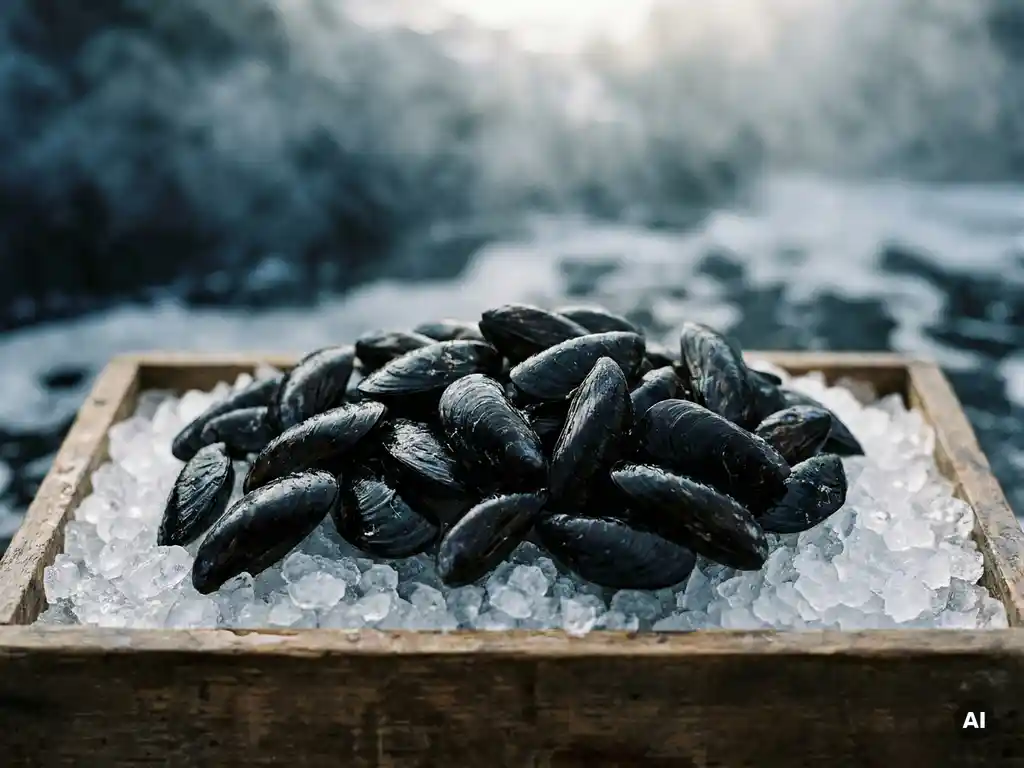
You can recognize fresh mussels by three things: they are still alive, they smell fresh of the sea, and their shells are closed or close when you tap them. Buying quality mussels starts with knowing what to look for, because a mussel that looks fine on the outside can still be spoiled. In this article, we answer the most frequently asked questions about recognizing good mussels, from smell and appearance to storage and the best season.
How can you tell if mussels are still alive?
A fresh mussel is still alive the moment you buy it. The simplest way to check this is by tapping the shell or pressing it lightly. If the shell closes, or is already closed, the mussel is alive. A shell that remains open and does not respond is a sign that the mussel is dead and should no longer be eaten.
Also watch out for mussels with broken or damaged shells. These no longer offer protection and are unsuitable for consumption. Discard them before cooking, along with any mussels that remain closed after cooking. A cooked mussel that does not open is not safe to eat.
What does the smell of mussels say about their freshness?
Smell is one of the most reliable indicators of mussels' freshness. Fresh mussels smell fresh, slightly salty, and like the sea. A neutral or mild briny smell means the mussels are in good condition. If they smell strong, fishy, sour, or like ammonia, they are no longer fresh and should not be used.
A slight sea smell is normal and even a sign of quality. That smell comes from the salty environment in which the mussel lived. Trust your nose: it is more reliable than the eye alone when judging the quality of mussels.
What do fresh mussels look like on the outside?
Fresh mussels have a shiny, dark shell that is closed or closes upon touch. The color varies from blue-black to dark brown, depending on the origin and the farming environment. The shells may be lightly covered with seaweed or amber-like growth; this is a sign that they come directly from the water.
Avoid mussels with a dull, dry, or cracked appearance. Shells with an unusual color or a slimy, dirty coating are also a warning sign. Good mussels look alive and moist, as if they have just been harvested from the sea.
What is the difference in quality between wild and farmed mussels?
In most cases, farmed mussels are more consistent in quality than wild mussels. They grow under controlled conditions, are regularly inspected, and have a predictable size and filling. Wild mussels can vary significantly in size, taste, and meat filling per catch, depending on the season and location.
Farmed mussels
The best-known farmed mussels in the Netherlands come from the waters of Zeeland, particularly from the Oosterschelde. They are cultivated on plots or on ropes and are harvested when they have reached the right size. This results in a consistent quality that is easy for professional kitchens to plan.
Cultivation methods
Various methods are employed in mussel farming. Bottom-culture mussels grow on the seabed and are harvested using trawl nets or specialized fishing equipment. Suspended-culture mussels grow suspended in the water on ropes or nets, which are emptied upon harvesting. Both methods can result in mussels of excellent quality, but they differ in taste and texture.
How do you store fresh mussels correctly at home?
Store fresh mussels in the refrigerator at a temperature between two and five degrees Celsius. Ensure they can breathe and never store them in a sealed environment without air circulation, as they will suffocate and die quickly.
Preferably use fresh mussels on the day of purchase or at the latest the day after. The longer they are stored, the greater the chance that they will spoil and become unsuitable for consumption. Always check them again before use: tap the shells and smell if they are still fresh. Discard any mussels that no longer respond or have an unpleasant odor.
When are mussels at their best to buy?
Mussels are at their best from June through February. The Zeeland mussel season generally runs from June, depending on the quality and conditions of that year. In the summer months and early autumn, the mussels are large, plump, and flavorful.
In the months of March to May, mussels are less suitable for consumption. During this period, they spawn, resulting in thinner and less filled mussels. The meat content is significantly lower and the flavor less pronounced. Those wishing to buy the best should choose mussels in season, preferably from a supplier who can indicate the origin and harvest date.
How Adri & Zoon helps with mussels and shellfish
As a professional buyer, you want to be certain that the mussels you buy are fresh, of good quality, and traceable back to the source. Adri & Zoon, a wholesaler of fish, crustaceans, and shellfish from Yerseke, offers exactly that. As a family business with over forty years of experience in the sector, it possesses in-depth product knowledge and direct relationships with reliable growers and fishermen.
- Strong traceability: the origin and route of every product can be easily traced, so that you, as a professional buyer, can inform your own customers about what is on their plates.
- Wide assortment: supplies Adri & Zoon a full range of fish and shellfish, from oysters and shrimp to salmon and whitefish, as a one-stop shop for the professional market.
- Thinking along with the customer: it is not just about delivering a product, but about offering a solution that aligns with your specific needs as a buyer, restaurateur, or catering company.
- Own transport: Adri & Zoon has its own fleet of trucks, ensuring quality remains guaranteed during transport.
- Product knowledge: the team has specialist knowledge of shellfish and is happy to share that knowledge so that you can serve your customers better.
Would you like to know more about the company or our way of working? Then read our story. Are you ready to collaborate, or do you have a specific question about mussels or other products? Contact Adri Adri & Zoon for personal advice.