

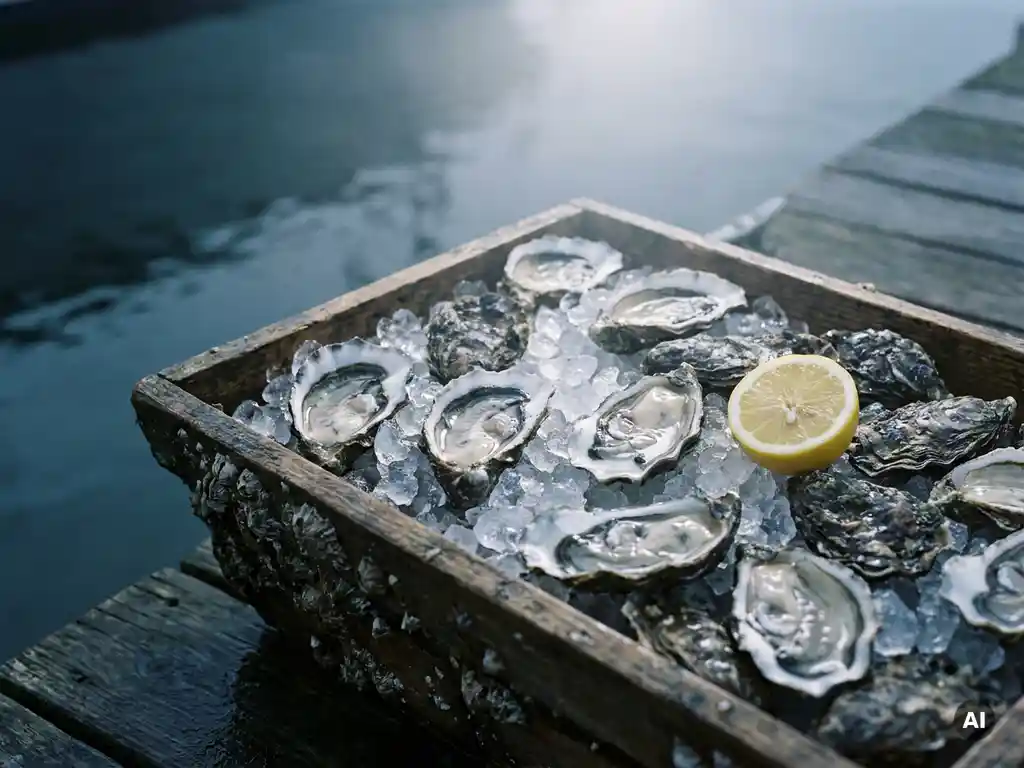
An oyster remains good for an average of five to seven days after the catch or harvest date, provided it is stored correctly. Shelf life depends heavily on temperature, humidity, and whether the shell is still closed. In this article, you will find answers to the most frequently asked questions about storing, identifying, and eating fresh oysters.
How do you recognize a fresh oyster?
A fresh oyster is tightly closed, smells of the sea, and has a clear, slightly briny liquid inside the shell. If you break open an oyster and it smells musty, sour, or ammonia-like, it is no longer good. A fresh oyster also reacts: if you tap the shell lightly, it retracts.
Pay attention to these signs when evaluating an oyster:
- Closed shell: an oyster that is open and no longer closes is dead and unfit for consumption.
- Scent: fresh and salty, comparable to seawater, never acidic or pungent
- Liquid: clear and present in the shell; cloudy fluid is a bad sign.
- Texture: the oyster meat is glossy and firm, not slimy or sunken.
If in doubt, throw the oyster away. The risk of food poisoning is too great to eat the oyster on a whim.
How long can you keep oysters in the refrigerator?
Unopened oysters can be stored in the refrigerator for five to seven days after the packaging or harvest date, provided they are kept cold enough. The ideal storage temperature is between 2 and 8 degrees Celsius. Always check the expiration date on the packaging, if present.
Once opened, an oyster is immediately perishable. It must be eaten within a few hours of opening the shell. Never store opened oysters in the refrigerator for later use.
Also take the following into account:
- Do not store oysters in a sealed plastic bag or airtight container: they breathe and need oxygen.
- Place them with the convex side down, so that the oyster liquid remains in the shell
- Do not place them next to strongly scented products, as oysters quickly absorb odors
How do you best store oysters at home?
The best way to store oysters at home is on a bed of crushed ice or in the refrigerator, with the rounded side down and covered with a damp cloth. This way, you retain the natural liquid in the shell and the oysters remain alive and fresh.
A practical, step-by-step approach:
- Place the oysters with the rounded side down in a bowl or container
- Cover them with a damp tea towel or paper towel
- Store them in the coldest part of the refrigerator, usually at the bottom or back
- Check daily whether all shells are still closed
- Replace the damp cloth if it dries out
store oysters in fresh water or standing water: this kills them quickly. Direct contact with meltwater from ice is also harmful. If you use ice, place a rack or cloth between the ice and the oysters.
Can you freeze oysters?
Technically, you can freeze oysters, but it is strongly discouraged for raw consumption. Freezing changes the texture: the meat becomes soft and watery, causing the typical experience of a fresh oyster to be lost. Frozen oysters are only suitable for cooking or incorporating into hot dishes.
If you do wish to freeze oysters for use in a prepared meal, open the oysters first, keep the liquid separate, and freeze the meat in a resealable freezer bag. The maximum storage time in the freezer is approximately three months. Always thaw them slowly in the refrigerator, never at room temperature.
What happens if you eat a spoiled oyster?
Eating a spoiled oyster can lead to severe food poisoning, with symptoms such as nausea, vomiting, diarrhea, and abdominal cramps. These symptoms typically develop within four to eight hours after consumption. In severe cases, particularly in people with a weakened immune system, a bacterial infection such as Vibrio be dangerous.
Oysters are eaten raw and are not heated before consumption, meaning any bacteria or viruses are not killed. This makes it especially important to always work with fresh, well-preserved oysters. If you have any doubts about the quality, do not eat the oyster; a bad oyster is rarely worth the effort.
Does the season matter for the shelf life of oysters?
Yes, the season affects both the quality and shelf life of oysters. In the summer months, when the water is warmer, oysters spawn more frequently. During that period, the oyster meat is softer, milkier, and less flavorful. Furthermore, oysters spoil faster at higher ambient temperatures.
The traditional rule of thumb is that oysters are at their best from September through April. During this period, the oysters are firmer, plumper, and more flavorful. Modern farming techniques and controlled cooling have partially reduced seasonality, but the taste and texture remain seasonal.
At high outdoor temperatures, such as in summer, extra caution is required during transport and storage. Ensure that oysters are always transported and stored chilled, and shorten the storage time if in doubt.
How Adri & Zoon helps professional buyers with oysters
As a professional buyer, you want to be certain that the oysters you purchase are fresh, traceable, and meet your customers' expectations. Adri & Zoon, based in Yerseke, specializes in the wholesale of fish, crustaceans, and shellfish and has built up years of expertise in top-quality oysters.
What Adri & Zoon offers for professional oyster buyers:
- Wide assortment: from Zeeland creuses and flat oysters to oysters from France and Ireland, including products from Gillardeau, of which Adri & Zoon is the official Benelux dealer: view the full range of fish and shellfish.
- Strong traceability: complete origin information per product, so you can tell your customers the story behind the oyster.
- Specialized product knowledge: in-depth knowledge of varieties, seasons, flavor profiles, and storage, so that you make informed purchasing decisions.
- Own transport: controlled delivery with our own trucks, so that the cold chain remains intact.
- Thinking along with the customer: from packaging requirements to delivery frequency: Adri & Zoon actively thinks along regarding your specific situation
Would you like to know more about the working methods and background of this family business? Then read our story. For questions about the product range or a collaboration, you can contact team Adri & Zoon.