

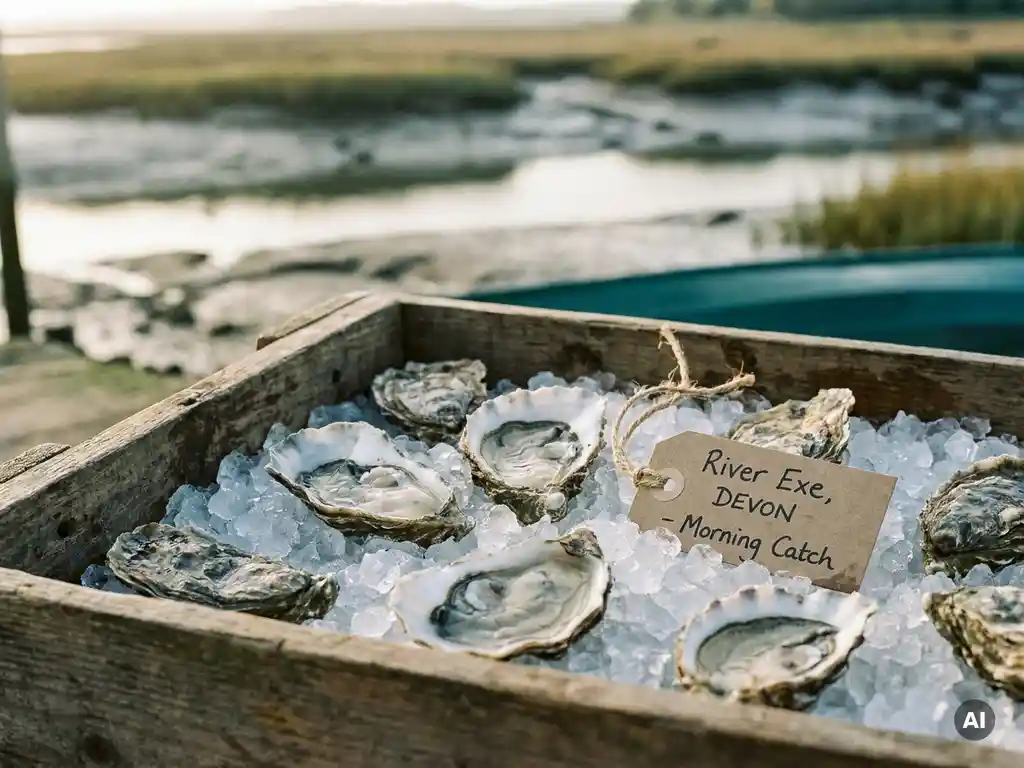
The origin of an oyster determines the quality, taste, and safety of the product. Where an oyster is farmed or caught determines what it eats, how it grows, and what character it develops. For professional buyers, knowledge of origin is therefore not a side issue, but an essential part of responsible sourcing. The questions below answer the most important aspects of origin when purchasing oysters.
What does the origin of an oyster say about its quality?
The origin of an oyster says something directly about the water quality, the food supply, and the farming period. Oysters filter enormous quantities of water, absorbing everything present in that water: minerals, algae, salt, and organic matter. The environment thus literally determines the taste and texture of the final product.
An oyster from a tidal area with a high salt concentration tastes different from an oyster from a sheltered lagoon with brackish water. Farming areas with a rich algae population produce oysters with full, creamy flesh, while areas with strong currents result in a firmer texture and a distinctly salty taste. In addition to taste, water quality also plays a direct role in the microbiological safety of the product. Farming areas in Europe are classified based on bacteriological standards, with Class A setting the strictest requirements. Therefore, anyone who knows where an oyster comes from also knows something about its safety.
Which oyster regions supply the most requested flavors?
The most sought-after oyster regions are located in France, the Netherlands, and Ireland. Each of these regions produces oysters with its own distinct flavor profile, determined by the specific conditions of the farming area. For professional buyers, knowing these regional differences is essential when curating an assortment.
- Normandy and Brittany (France): Famous regions for fine, briny oysters with a complex flavor. The Gillardeau oyster, originating from Charente-Maritime, is considered one of the most prized premium oysters in the world.
- Zeeland (Netherlands): The Zeeland oyster grows in the Oosterschelde, a protected Natura 2000 area. The tidal water and rich food environment give this oyster a full, slightly nutty flavor.
- Ireland: Irish oysters grow in cold, clear Atlantic waters and are known for their freshness and light saltiness. They are popular in the hospitality industry due to their consistent quality.
Knowledge of these regions helps buyers not only select the right quality oysters, but also align the supply with the wishes of their own customers.
How does traceability work for oysters in practice?
Traceability for oysters means that the entire chain from cultivation site to delivery is documented and verifiable. In practice, this is achieved through a combination of legal obligations and administrative systems that record the origin and route of the product.
European legislation requires oysters to be accompanied by a label containing information about the species, the farming area, the farming date, and the classification of the production area. This label remains mandatory up to the end user. In the chain, every link maintains records of incoming and outgoing batches so that, in the event of a quality problem or food safety incident, the origin of the product can be quickly traced.
In practice, however, the quality of traceability depends heavily on how seriously suppliers maintain it. A label is a legal minimum; a supplier who can also reconstruct the route, transport conditions, and intermediate links offers a significantly more reliable guarantee. For professional buyers, it is therefore worthwhile to ask how a supplier ensures traceability in practice, not just whether a label is present.
What is the difference between farmed and wild oysters?
Farmed oysters are raised under controlled conditions on oyster beds or in cultivation nets, whereas wild oysters grow naturally on rocks, reefs, or the seabed without human intervention. The main difference lies in predictability: farmed oysters offer more consistent quality, while wild oysters vary more in size, taste, and availability.
By far the largest proportion of commercially sold oysters is farmed. Growers actively manage factors such as growth duration, density, and location, resulting in a product that is easier for professional buyers to plan. Wild oysters, such as the European smooth oyster (Ostrea edulis) in their native habitat, are scarcer and are considered a delicacy with a distinct, complex flavor profile. Availability is seasonal and limited.
For most hospitality and retail applications, farmed oysters are the most practical choice. Wild oysters are an interesting premium offering for customers looking for unique products with a strong story.
When is an oyster with a label of origin actually traceable?
A label indicating the origin of an oyster only makes it truly traceable if the information on that label is actually verifiable and aligns with continuous records throughout the chain. A label stating a farming area is a legal requirement, but it says nothing about the reliability of the information or the verifiability of the subsequent route.
True traceability goes beyond a label. It means that a supplier can demonstrate which batch was purchased at what time, from which grower, how the product was transported, and under what conditions it was stored. This requires active records, not just a label that is legally required.
When assessing a supplier's traceability, the following questions are relevant:
- Can the supplier specify the specific cultivation location, not just the region?
- Is the transport chain documented, including temperature conditions?
- Is there a system to quickly identify all parties involved in a recall?
- Does the supplier buy directly from growers, or through intermediaries?
The shorter the chain and the more direct the relationship with the grower, the more reliable the traceability generally is.
How does knowledge of origin help in selling oysters to end customers?
Knowledge of origin helps sell oysters because it offers a concrete story that end customers understand and appreciate. Consumers buy oysters not only for taste, but also for the experience. Anyone who can explain where an oyster comes from, how it is farmed, and what makes the region special gives their customer a reason to choose and return.
In practice, knowledge of origin translates into stronger sales opportunities. A fish shop or restaurant that can distinguish a Zeeland oyster from a Norman oyster, and can explain that difference to the customer, positions itself as a specialist. This increases trust and justifies a higher price. Origin is therefore not only a quality argument for the buyer, but also a selling point for the consumer.
Concrete examples of how knowledge of origin supports sales:
- Taste descriptions by region make the offering concrete and distinctive on menus and in the store.
- The story behind a premium oyster, such as the Gillardeau, gives hospitality customers a topic of conversation at the table.
- Seasonal origin calls for a changing supply and active communication with customers.
- Traceability to the consumer strengthens confidence in the quality of the product.
How Adri & Zoon helps with sourcing oysters, mussels, and shellfish
Adri & Zoon is a specialized wholesaler of fish, crustaceans, and shellfish with years of experience in sourcing, processing, and supplying oysters to professional clients. As an official Gillardeau dealer in the Benelux and with direct purchasing relationships with growers worldwide, Adri & Zoon more than just a product. The company also offers the story and the knowledge that professional buyers need to properly inform their own clients.
What distinguishes Adri & Zoon when sourcing oysters:
- Strong traceability: Adri & Zoon can accurately trace the origin and route of oysters, from farming area to delivery.
- Specialized product knowledge: Extensive knowledge of oyster varieties, regions, and flavor profiles, available to clients who wish to substantiate their own offerings.
- Wide assortment of oysters and shellfish: From Zeeland oysters to premium Gillardeau, supplemented with mussels and other crustaceans and shellfish.
- Thinking along with the customer: Adri & Zoon actively helps determine which offering suits the specific customer needs, whether it concerns a fish shop, restaurant, or catering company.
- Own transport: Full control over delivery, ensuring quality remains guaranteed until the destination.
Would you like to know more about the oyster selection or how Adri & Zoon collaborates with your purchasing needs? Contact us for a no-obligation consultation with one of the specialists.