

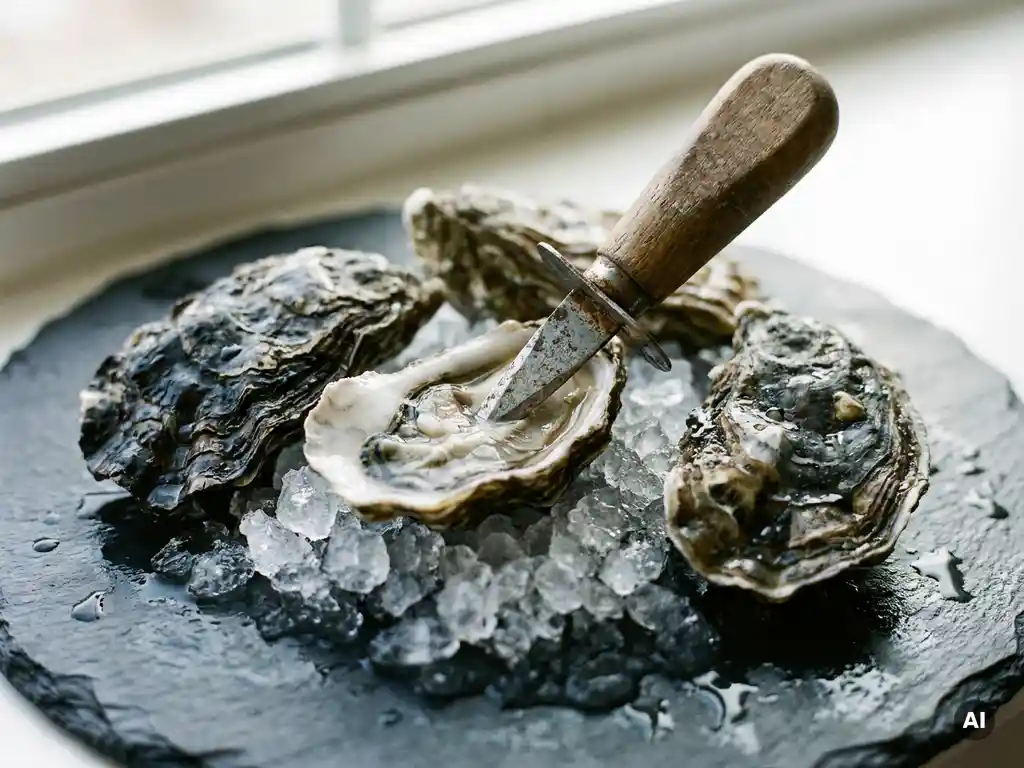
You can open oysters safely and effortlessly with an oyster knife, a sturdy cloth, and the right technique. Pierce the knife through the hinge at the back of the oyster, twist the knife to break the shell, and slide it along the top shell to cut the muscle loose. With some practice, opening oysters becomes smooth, and you will never get injured again. In this article, we answer the most frequently asked questions about opening oysters: from the right tools to storage and serving.
What tools do you need to open oysters?
To safely open oysters, you need at least two things: an oyster knife and a sturdy cloth or oyster glove. The oyster knife has a short, sturdy blade with a pointed tip and is specially designed to reach between the shell valves. A regular kitchen knife is too long, too thin, and too dangerous for this work.
A good cloth or cut-resistant glove protects your hand if the knife slips. Oysters have a rough, irregular shell, and due to the force required to break the hinge, a slip is easily made. This is, therefore, the most common cause of cuts when opening oysters.
An oyster clamp or oyster holder is optional but handy. This is a wooden or metal tool used to hold the oyster in place while you work. Professional kitchens use this tool as standard, as it significantly increases speed and safety when opening larger numbers of oysters.
- Oyster knife: short, sturdy blade with a pointed tip
- Cloth or cut-resistant glove: protects the hand holding the oyster
- Oyster clamp or oyster holder: optional, but improves speed and safety
How do you open an oyster step by step?
Open an oyster by inserting the knife into the hinge, twisting to break the shell, then sliding the knife along the top shell to cut the adductor muscle, and finally removing the top shell. Always keep the hollow side facing down so that the liquid remains in the shell.
- Wrap the oyster in a cloth with the hollow side down and the hinge facing you. Hold the oyster firmly without squeezing.
- Insert the oyster knife into the hinge. Locate the small opening between the two shell valves at the back. Use targeted pressure, not force. The knife should slide in with a small movement.
- Turn the knife like a lever. Move the handle downward or sideways so that the shell valves are forced apart. You will hear or feel a slight crack when the hinge breaks.
- Slide the knife along the top shell. Hold the knife flat against the inside of the top shell and cut through the adductor muscle. Do this carefully so as not to damage the oyster meat.
- Remove the top shell and check that there are no small fragments on the oyster meat. Remove loose pieces of shell with the tip of a knife or a clean cloth.
- If necessary, cut the lower muscle loose. Some chefs also cut the muscle at the bottom loose so that the oyster slides off the shell more easily when serving.
Why do you sometimes fail to open oysters?
Opening oysters usually fails because the knife is not placed precisely in the hinge, or because too much brute force is used instead of a twisting motion. The hinge is the oyster's weakest point, but the opening is small and requires a precise approach.
Another common cause is the wrong oyster knife. A blade that is too wide or too long will not grip the hinge. Always use a knife specifically made for oysters.
Sometimes the oyster itself also plays a role. A fresh, live oyster has a strong adductor muscle and holds the shell firmly closed. This is actually a sign of quality, but it makes opening it slightly more difficult. Oysters that are already open or no longer respond to touch are no longer fresh and should not be consumed.
Finally, the position of the oyster can make all the difference. Ensure that the hinge is always facing you and that you hold the oyster steadily. A slipping oyster is not only frustrating but also dangerous.
Can you open oysters without an oyster knife?
Opening oysters without an oyster knife is possible, but less safe and less precise. The most commonly used alternatives are a sturdy screwdriver, using the oven or microwave, or the grilling method. Each of these methods has disadvantages compared to the classic technique with an oyster knife.
Opening oysters with a screwdriver
A small, flat screwdriver can serve as an emergency solution. Pierce the tip into the hinge and use the same twisting motion as with an oyster knife. The risk is greater because a screwdriver has less grip and is more likely to slip. Always use a sturdy cloth or glove and exercise extra caution.
Open oysters with heat
By briefly placing oysters in a hot oven (around 200 degrees) or on a hot grill, the adductor muscle relaxes and the shell opens slightly. This makes opening easier, but the oyster cooks slightly in the process. Therefore, this method is not suitable for preparing them raw. However, for warm oyster dishes, it can be a useful technique.
How do you store and serve opened oysters?
Store opened oysters in the refrigerator for a maximum of one to two hours, covered with a damp cloth. Serve them as soon as possible after opening, preferably on a bed of crushed ice to keep the temperature low. The shorter the time between opening and serving, the better the taste and texture.
For presentation, place the oysters on the bottom shell, with the hollow side facing up so that the liquid remains inside. Classically, oysters are served with a slice of lemon, a red wine vinegar mignonette sauce with shallots, or a drop of Tabasco. In a professional kitchen, the shells are sometimes presented on sea salt or seaweed for extra stability and visual appeal.
Oysters that you are not serving immediately are best stored unopened in the refrigerator at a temperature between two and eight degrees Celsius. Place them hollow side down so that the moisture remains in the shell and the oyster does not dry out. Unopened oysters kept this way are usually keepable for a few days, depending on how fresh they are at the time of purchase.
- Serve opened oysters within one to two hours
- Use crushed ice for presentation and temperature retention
- Store unopened oysters with the hollow side down in the refrigerator
- Always check if unopened oysters are still alive before use
How Adri & Zoon helps with working with oysters
For professional kitchens that regularly work with oysters, quality begins with sourcing. Adri & Zoon is a specialized fish wholesaler with in-depth knowledge of oysters, from origin and farming methods to presentation and processing. As an official Gillardeau dealer in the Benelux, the company also supplies the most sought-after premium oyster varieties.
What sets Adri & Zoon apart for hospitality professionals:
- Wide assortment of oysters, including Fines, Spéciales and Gillardeau
- Strong traceability: the origin and route of every product can be easily traced
- Delivery six days a week from Yerseke, with our own transport
- Specialized product knowledge regarding oysters, so that chefs can properly inform their guests
- Custom packaging, tailored to the customer's wishes
Would you like to know more about the range, or are you curious about what Adri & Zoon can do for your kitchen? Contact us for personal advice.